





 Security guarantees
100% secure payments: PayPal, Visa, MasterCard, bank cards, alternative payments.
 Delivery policy
Deliveries by Mondial Relay or Colissimo (French fast postal service).
 Returns policy
Returns accepted up to 14 days after delivery
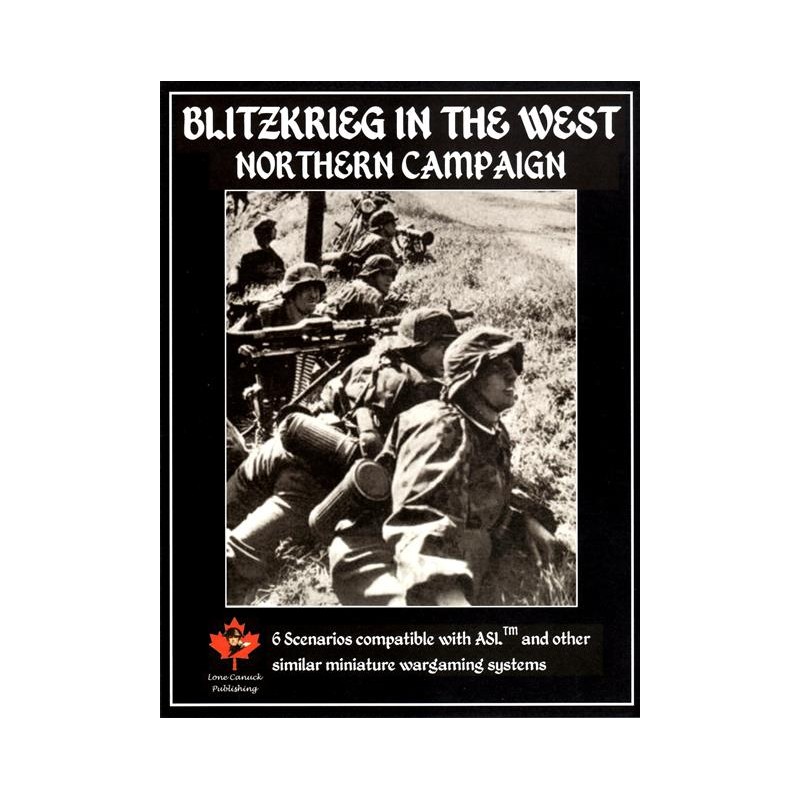
Blitzkrieg in the West: Northern Campaign is an Advanced Squad Leader (ASL) scenario pack covering the German invasion of the Netherlands in May 1940 and related fighting in the northern sector of the Western Front.
The module features six historical scenarios depicting the German offensive against Dutch forces, focusing on bridges, canals, road networks, and improvised defensive positions. It highlights the speed of the Blitzkrieg, the fragility of Dutch defenses, and the importance of controlling key crossing points.
Game System
The module is designed for Advanced Squad Leader, the benchmark tactical system for WWII squad-level combat.
The scenarios emphasize early-war characteristics such as light infantry, non-standardized armored units, motorized reconnaissance, and fragmented Dutch defenses. A linked campaign system connects the scenarios, tracking results and influencing subsequent battles.
Included Scenarios
BWN-1 – Their Baptism of Fire
May 10, 1940 – Maas–Waal Canal
First clashes between German SS units and Dutch defenders over a key crossing point.
BWN-2 – The Veluwe
May 10, 1940 – Veluwe region
Mobile engagements between fast-moving German forces and Dutch units attempting to slow the invasion.
BWN-3 – The Maas Line
May 10–11, 1940 – Maas defensive line
Fighting along Dutch defensive positions under mechanized German assaults.
BWN-4 – Brush at Tilburg
May 11, 1940 – Tilburg
Mixed urban and rural combat in a key communications area.
BWN-5 – Breda Bash
May 11–12, 1940 – Breda
Meeting engagement with high mobility and extensive use of light vehicles.
BWN-6 – End of the Line
May 12–13, 1940 – Southern Netherlands
Final battles of the campaign as Dutch resistance collapses.
Objective
Each scenario features historical objectives such as bridge seizure, defensive line breakthrough, road network control, or enemy destruction.
The campaign system links scenario outcomes to simulate the rapid German operational tempo.
Players
2 players
Playing Time
2–5 hours per scenario
Campaign playable across multiple sessions
Complexity
High
Designed for experienced ASL players, especially in early-war and mechanized combat
Replayability
6 linked scenarios
Campaign system with victory point tracking
Variable orders of battle
Strong asymmetry between mechanized offense and improvised defense
Components (indicative)
6 ASL scenarios
Campaign system
Scenario cards
Additional counters (depending on edition)
Historical notes and special rules