





- New
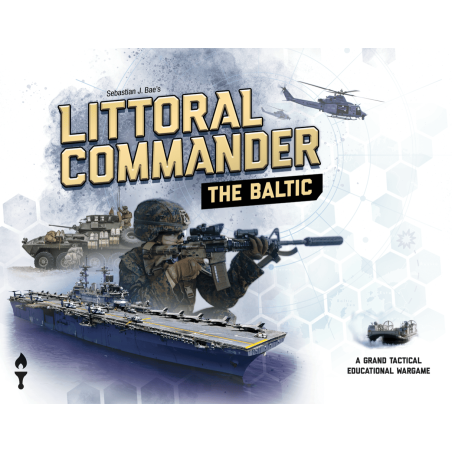

An essential series for anyone interested in modern warfare!
 Security guarantees
100% secure payments: PayPal, Visa, MasterCard, bank cards, alternative payments.
 Delivery policy
Deliveries by Mondial Relay or Colissimo (French fast postal service).
 Returns policy
Returns accepted up to 14 days after delivery
Publisher: The Dietz Foundation
Designer: Sebastian J. Bae
Co-Designer: Nick Wernert
Design Team: Mac Kramer, Ian Brown, Paul Kearney, Nicolas “Nikolai” Rice, Patrick McLaughlin
Layout & Graphics: Jacob Walker
Players: 2–6
Playing Time: 60–240 minutes
Recommended Age: 14+
Language: English
Period: Modern Warfare / Near-Future Conflict
System: Littoral Commander
Littoral Commander: The Baltic is a modern wargame in which two opposing sides — or several players organized into teams — explore potential conflicts in the Baltic Sea region in the near future.
The second installment in the Littoral Commander series, the game builds on the system originally designed to explore the challenges of modern multi-domain warfare. It combines the familiar framework of a hex-and-counter wargame with a card-driven system representing military, technological and operational capabilities.
Rather than recreating a specific historical campaign, The Baltic is designed as a sandbox operational game, allowing players to experiment with different approaches to a modern conflict. Reconnaissance, joint coordination, long-range strikes and, above all, logistics are central to the game.
The game focuses on hypothetical conflicts and crises in the Baltic region of Europe, including scenarios involving US and Russian forces.
The Baltic introduces a number of new units and capabilities designed specifically for this theatre, including:
One of the game's key new mechanics concerns naval preparation. Players must configure their ships for a campaign, carefully balancing available space and resources. Logistics therefore becomes an integral part of operational planning rather than simply a supporting mechanism.
Despite the breadth of the subject, the Littoral Commander system is designed to remain accessible. The publisher states that the system can be learned quickly, while individual scenarios can be completed in approximately 2–3 hours.
The system makes extensive use of Joint Capability Cards (JCCs) to represent the specialized capabilities available to the forces involved. Players combine movement and unit activation on the map with card play representing intelligence, strike, support and other modern military capabilities.
The result is a modern wargame that provides a broad view of multi-domain warfare without requiring the extremely detailed simulation found in some contemporary operational and tactical wargames.
The game includes:
The referenced rulebook is identified as Rules Version 2.3.
With The Baltic, Sebastian J. Bae brings the Littoral Commander system to one of the most strategically sensitive regions of contemporary Europe.
The game focuses on the problems of detection, initiative, coordination and resource management, rather than simply measuring combat strength and attrition. Players must decide when to commit their capabilities, when to preserve them and how best to coordinate their forces across several domains.
An original modern wargame for players interested in contemporary warfare, joint operations, naval and amphibious warfare, logistics and hypothetical future conflicts.

Data sheet
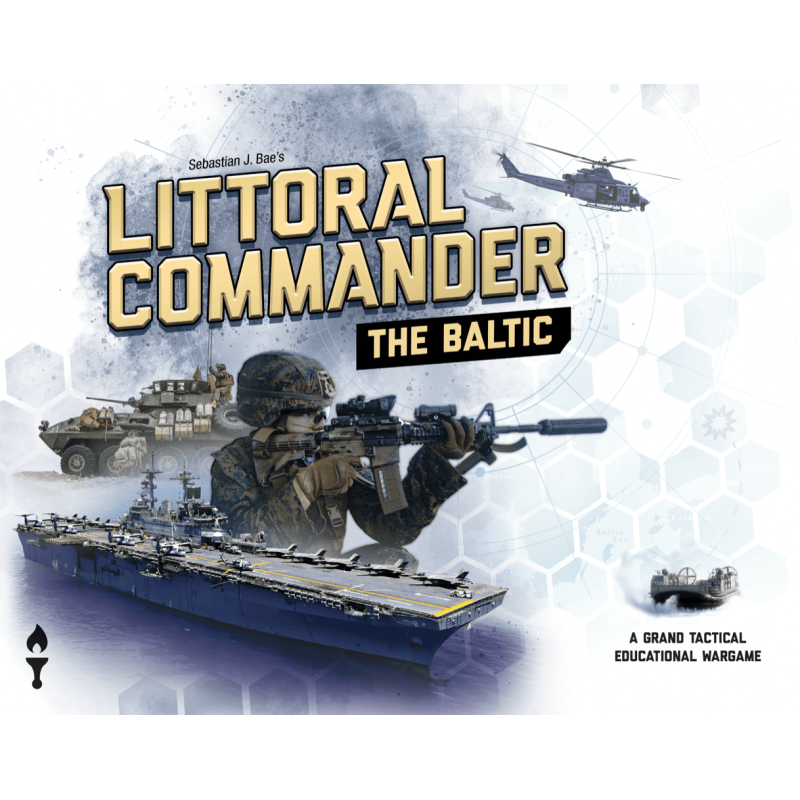
An essential series for anyone interested in modern warfare!