




- New


 Security guarantees
100% secure payments: PayPal, Visa, MasterCard, bank cards, alternative payments.
 Delivery policy
Deliveries by Mondial Relay or Colissimo (French fast postal service).
 Returns policy
Returns accepted up to 14 days after delivery
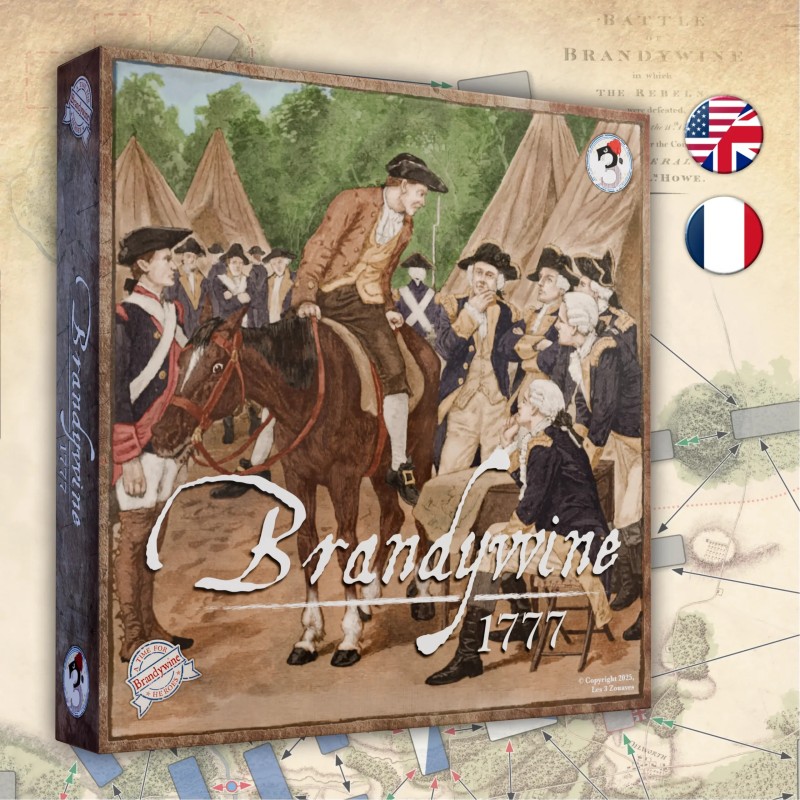
Brandywine, 1777 – A Time for Heroes puts you in command of one of the two armies engaged in the Battle of Brandywine on September 11, 1777, during the American Revolutionary War. Take the role of British General William Howe or George Washington and attempt to determine the outcome of this crucial battle.
Following the capture of New York in 1776, the British army under Howe set its sights on Philadelphia, the political heart of the American rebellion. Washington attempted to block the British advance by using the Brandywine River as a defensive line.
But the situation was far from clear. British manoeuvres and uncertainty about the location of the enemy's main columns played a crucial role in the historical battle.
Brandywine, 1777 – A Time for Heroes recreates this tension through a system combining Formation activations, cohesion management and difficult command decisions. The American player must deal with uncertainty and gradually discover where the main British forces are located.
The game revolves around the coordinated activation of military Formations.
Each side has Formation Activation Cards that determine which formations can act. When a Formation is activated, the player may choose to:
Each Formation has a limited amount of Cohesion, which decreases when it is activated for movement or combat. Players therefore have to constantly balance the exploitation of tactical opportunities against the preservation of their forces.
Activating Formations also generates Momentum, represented by cubes. Momentum can be spent to acquire Tactical Cards, providing special actions that can influence the course of the battle, and can also be used to obtain re-rolls during combat.
Victory is achieved through objectives including the destruction of enemy Formations and the occupation of strategic locations.
One of the game's key features is its attempt to reproduce the uncertainty faced by Washington during the historical battle.
The designer sought to create this uncertainty without the use of a screen or hidden-information barrier, making the unknown position and intentions of the British forces a central part of the experience.

Data sheet