



- New


 Security guarantees
100% secure payments: PayPal, Visa, MasterCard, bank cards, alternative payments.
 Delivery policy
Deliveries by Mondial Relay or Colissimo (French fast postal service).
 Returns policy
Returns accepted up to 14 days after delivery
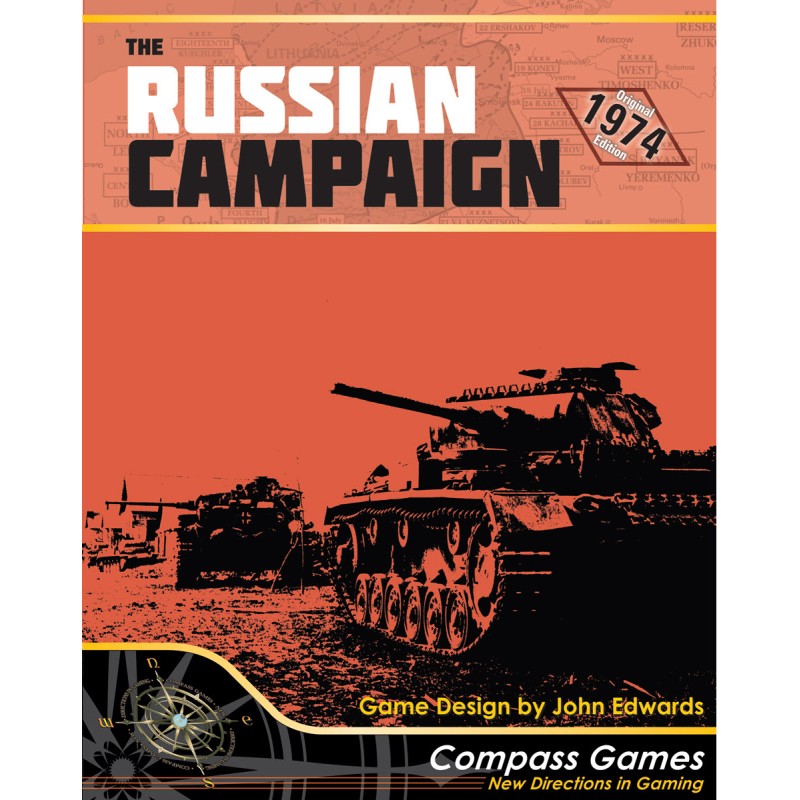
The Russian Campaign, Original 1974 Edition is Compass Games' remake of one of the great classics of historical wargaming, originally designed by John Edwards and first published in Australia by Jedko Games in 1974.
The game covers the Eastern Front of World War II, beginning with the German invasion of the Soviet Union on June 22, 1941. It focuses on the decisive strategic problems of the campaign: the German need for a rapid victory and the Soviet need to survive the initial onslaught and build enough strength to turn the tide of the war.
The German player commands a highly mobile force with considerable offensive power. The opening campaign is therefore a race against time: German forces must advance rapidly, surround Soviet armies and achieve decisive results before the weather deteriorates and Soviet reserves begin to restore the balance.
The Soviet player faces the opposite challenge. The initial objective is survival. Soviet forces must absorb the German offensive, make effective use of reserves and reinforcements, and eventually launch counter-attacks against an increasingly overstretched German army.
Despite covering an enormous theatre of operations, the game uses a deliberately accessible rules system. Weather, rail movement, naval movement, headquarters, Stuka units, Soviet airborne units, combat supply, isolation, partisan activity and replacements are all represented without turning the game into an overly complex simulation.
Compass Games describes the game as a low-complexity, fast-playing wargame that is suitable for newcomers while still offering experienced players a tense strategic contest.
We lists the Compass Games edition as a 2021 release, with Bruce Yearian credited as artist. The original game itself was first published by Jedko Games in 1974 and subsequently became one of the best-known Eastern Front wargames.
On June 22, 1941, Germany launched Operation Barbarossa against the Soviet Union. More than three million German troops and their allies invaded Soviet territory, achieving spectacular initial successes.
Large Soviet formations were surrounded and captured, while German armoured and motorized formations advanced deep into the Soviet Union. However, the campaign did not produce the quick victory expected by the German leadership.
The diversion of forces toward the Kiev encirclement, the resulting loss of time, logistical difficulties and the arrival of winter prevented the Germans from achieving their decisive objectives. In December 1941, the Soviet counter-offensive around Moscow marked a major turning point: the short war Germany had planned had failed.
We also identifies rail and sea movement, invasions, Stukas, partisan activity, SS units, automatic victory conditions and double-impulse movement among the game's notable features.
The Russian Campaign is a classic example of an accessible strategic wargame that successfully captures the major dynamics of a huge historical campaign.
The two sides have fundamentally different objectives: Germany must win quickly, while the Soviet Union must survive long enough to reverse the strategic situation.
This asymmetry creates a highly tense game in which every German offensive must be carefully planned, while the Soviet player must decide when to sacrifice territory, when to preserve forces and when to begin the counter-offensive.
A landmark Eastern Front wargame and an excellent choice both for newcomers to strategic wargaming and for experienced players looking for a relatively quick but strategically demanding classic.
Data sheet