






 Security guarantees
100% secure payments: PayPal, Visa, MasterCard, bank cards, alternative payments.
 Delivery policy
Deliveries by Mondial Relay or Colissimo (French fast postal service).
 Returns policy
Returns accepted up to 14 days after delivery
“The Coastwatchers saved Guadalcanal, and Guadalcanal saved the South Pacific.”
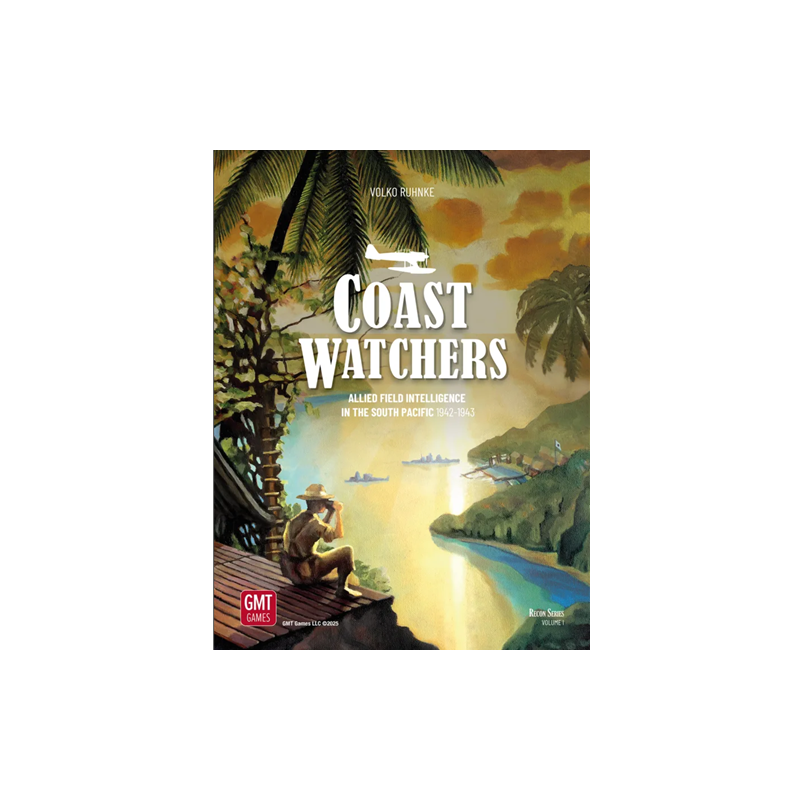
Far from the great carrier battles and amphibious assaults of the Pacific War, another conflict was being fought in the jungles and islands of the South Pacific: a hidden war of intelligence, surveillance, deception and counter-intelligence.
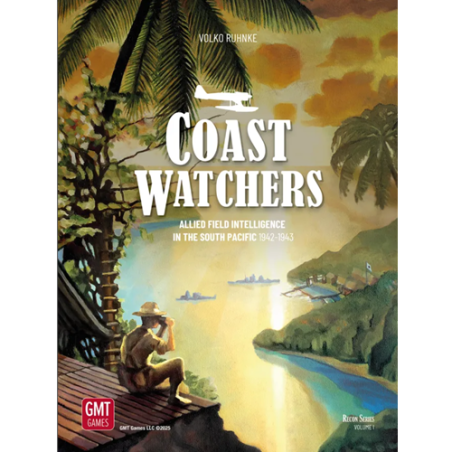
Coast Watchers places players at the heart of this struggle between Allied intelligence networks and Japanese forces attempting to locate and destroy them.
From the Japanese expansion into the South Pacific in 1942 to the neutralization of the major Japanese base at Rabaul in late 1943, the game explores one of the less frequently represented aspects of the Pacific War.
The coastwatchers formed a vital Allied intelligence network. Operating from isolated islands and hidden observation posts, they monitored Japanese naval and air movements and transmitted critical information to Allied headquarters.
In effect, these observers acted as human early-warning systems, allowing Allied forces to prepare for incoming attacks and anticipate Japanese operations.
In Coast Watchers, information itself becomes the central weapon.
The Allied player must establish and maintain an intelligence network, observe Japanese preparations and report critical information. Meanwhile, the Japanese player attempts to conduct military operations while hunting down the Allied observers hidden throughout the theatre.
Secrecy and uncertainty are at the core of the game's system.
Stand-up blocks conceal coastwatching stations, guerrillas, refugees and stranded Allied personnel. The specially recessed game board keeps the blocks securely in place while reinforcing the hidden-information nature of the game.
Facedown counters conceal Japanese military preparations, while other markers are used in a draw system to determine Japanese search operations and Allied delivery missions.
Both sides also employ specialised cards:
The result is an asymmetric contest in which observation, deduction and deception are just as important as operational planning.
Coast Watchers offers a substantial range of scenarios:
The game covers the evolution of the South Pacific campaign from the Japanese advance in early 1942 through the eventual neutralization of Rabaul in late 1943.
The variety of situations provides strong replayability and allows players to explore different operational challenges across the campaign.
A dedicated solitaire mode is also included.
Coast Watchers offers a distinctive perspective on the Pacific War. Rather than placing players directly in command of armies or fleets, it focuses on the intelligence networks operating behind enemy lines and the constant struggle between observation and detection.
Designed by Volko Ruhnke, the game combines hidden information, asymmetric objectives and operational tension in a unique treatment of the secret war that helped shape the South Pacific campaign.

Data sheet